Here's the thing nobody tells you about photographing waterfalls in the southern Appalachians: a gray, drizzly day will almost always beat a blue one. Bright sun blows out the white water and throws hard shadows across the rocks. Flat, overcast light does the opposite — it holds detail in the spray, saturates the wet stone and moss, and lets you slow your shutter down without a fight. The worst-looking forecast often makes the best shooting day.
I've photographed the waterfall hikes near Asheville in every season and most kinds of weather — full flow after days of rain, ice after a hard freeze, low summer trickle, peak fall color. This isn't a hiking guide that happens to mention photography. It's the photographer's version: where to stand, when to go, which lens earns its place in your pack, and which falls are worth driving over the Tennessee line for.
Why the Southern Appalachians Are Waterfall Country
The mountains around Asheville sit along the Blue Ridge Escarpment, where the land drops steeply toward the piedmont below. Rivers and creeks running off that edge have nowhere to go but down, and over centuries they've carved hundreds of waterfalls into the rock. Transylvania County, just southwest of Asheville, calls itself the Land of Waterfalls for a reason.
This corner of the country is also one of the wettest in the eastern United States. All that rain keeps the rivers full and the forests thick with the moss, fern, and rhododendron that frame these falls and make them worth photographing in the first place. The same geography that makes the hiking good makes the photography good.
The Waterfalls Worth the Drive
I've ordered these from the easiest and most-photographed down to the one you'll likely have to yourself. Start at the top of the list when you're short on time. Work your way down when you want something fewer people have seen.
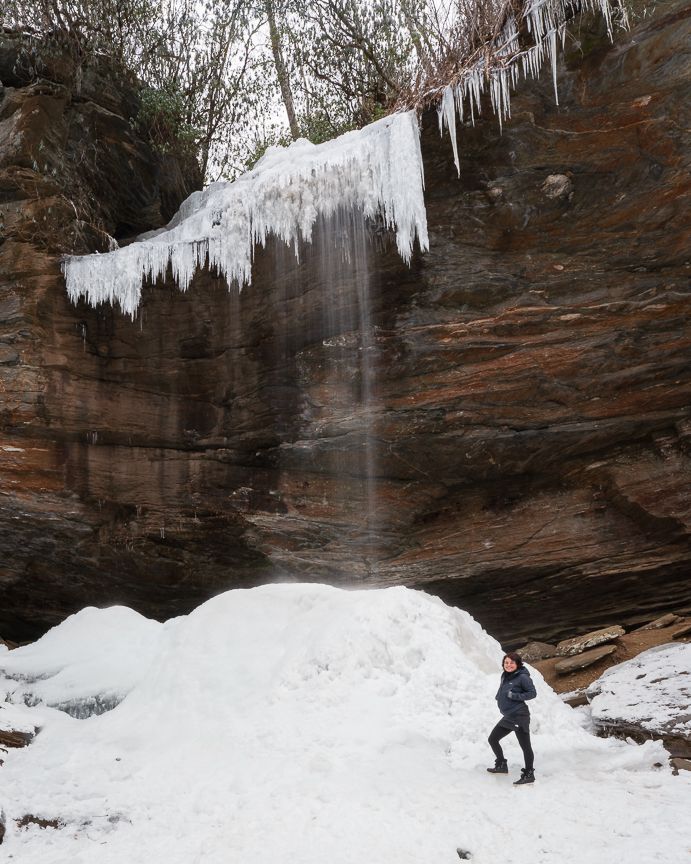
Moore Cove Falls in Winter
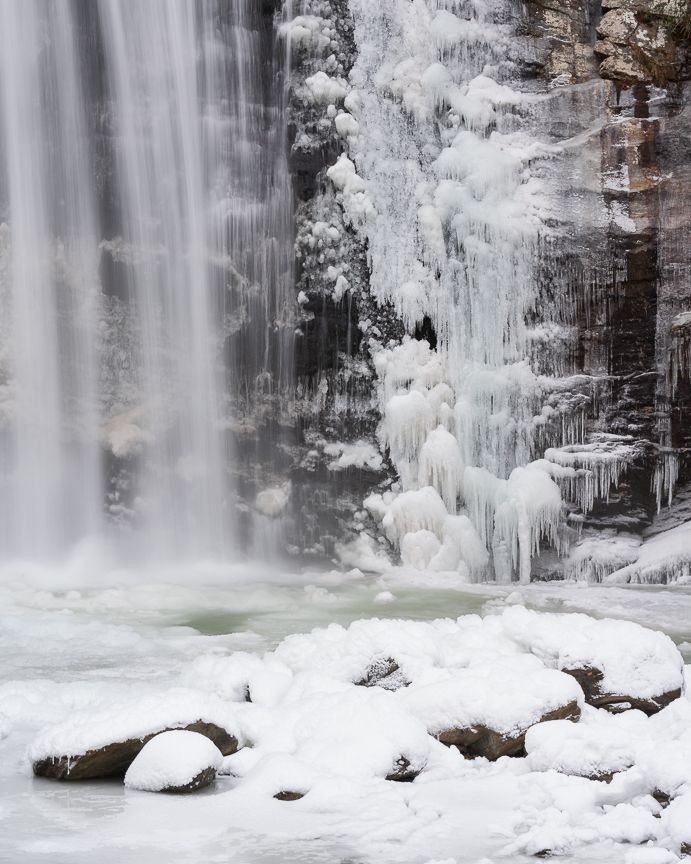
Frozen detail of Looking Glass Falls
Looking Glass Falls and Moore Cove Falls
Looking Glass is probably the most photographed waterfall in Western North Carolina, and it earns the attention — it's genuinely beautiful, and you can shoot it from a viewing platform a few steps from the road. That accessibility is also the catch. Everyone has the platform shot. To come away with something different, you have to be willing to climb down onto the rocks, or into the water itself, and work the scene from there. When the flow is full, I reach for a telephoto and isolate the detail of the water folding against the rock instead of trying to take in the whole face. Spring and fall are my favorite times here, when foliage closes in around the river and gives you something to frame the falls with.
Moore Cove sits a few miles farther up Highway 276 toward the Parkway, and it's the natural second stop — the two are close enough and easy enough to do in one outing. It's smaller than Looking Glass, but it lets you get right up underneath, and you can walk behind the curtain of water entirely. Go wide here; the appeal is the cave-like vantage from behind the falls. Both spots are excellent in winter too, especially after a stretch of unusually cold days when the edges start to freeze.
One honest warning: both trailheads fill fast. If you want either of these to yourself, go early on a weekday.
The details
- Looking Glass Falls: Roadside viewing platform on Highway 276, Pisgah National Forest — steps from the parking pullout. About one hour from Asheville.
- Moore Cove Falls: Short, accessible trail a few miles past Looking Glass on Highway 276. Roughly 1.3 miles round trip.
- Best lens: Telephoto for Looking Glass detail; wide angle for Moore Cove.
- Best conditions: Overcast; full flow after rain; ice after a hard freeze; spring and fall foliage.
- Crowds: Heavy. Arrive early on a weekday for solitude.
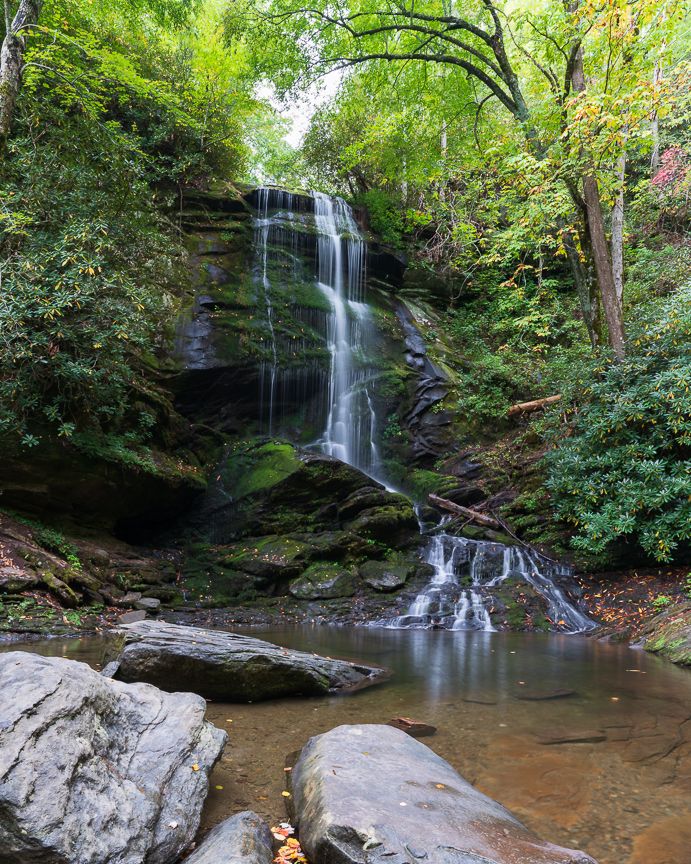
Catawba Upper Falls
Catawba Falls
Catawba Falls is one of the easiest to reach from Asheville, with ample parking — which means it gets busy on weekends. Do the full loop; it's the only way to see both the lower cascade and the upper falls, though it comes with a hefty stair climb I wouldn't recommend for small dogs or anyone uneasy with heights. Calling it a waterfall undersells what it actually is for most of its length: a tall cascade that streams over boulders and around ferns in ribbons of water. How wide those ribbons run depends entirely on recent rain, so time your visit for a few days after a good soak. The uppermost tier behaves more like a true waterfall.
A wide-angle lens is the only way to take in the full height. Once you've got that frame, though, the more interesting work is often in the details — the delicate plants and foliage growing right in the spray, picked out with a telephoto.
The details
- Location: Near Old Fort, NC. Ample parking. About 35 minutes from Asheville.
- Trail: Full loop to see both upper and lower falls; significant staircase. 3.6 miles.
- Note: Not ideal for small dogs or anyone with a fear of heights.
- Best lens: Wide angle for the full cascade; telephoto for detail.
- Best conditions: A few days after rain for flow; overcast skies.
- Crowds: Busy on weekends.
Rock Creek Falls
Cross the Tennessee line and you reach Rock Creek, the one fall on this list I've never once seen crowded. The trail is moderate and follows the creek to a two-tier fall that drops over heavily textured cliffs — surfaces that fill in with moss and fern through the warmer months and reward a close look. It sits deep in a shaded cavern, which is a gift for a photographer: there's no harsh light to fight, so you can shoot it well at any hour of the day, not just the edges.
The trail crosses the creek several times, so bring trekking poles or wear shoes you don't mind getting wet. It stays accessible in winter, but the elevation gain and length make it a real workout with snow on the ground. Go wide for the falls themselves, then switch to a telephoto to chase the patterns in that textured rock face.
The details
- Location: Rock Creek Recreation Area, just over the Tennessee border. Parking fee. Within about 90 minutes of Asheville.
- Trail: Moderate, follows the creek; multiple stream crossings — bring poles or water-friendly shoes. 4.3 miles, out-and-back.
- Best lens: Wide angle for the falls; telephoto for the rock detail.
- Best conditions: The shaded cavern shoots well all day; warmer months for the moss and fern.
- Crowds: Light. Rarely busy.
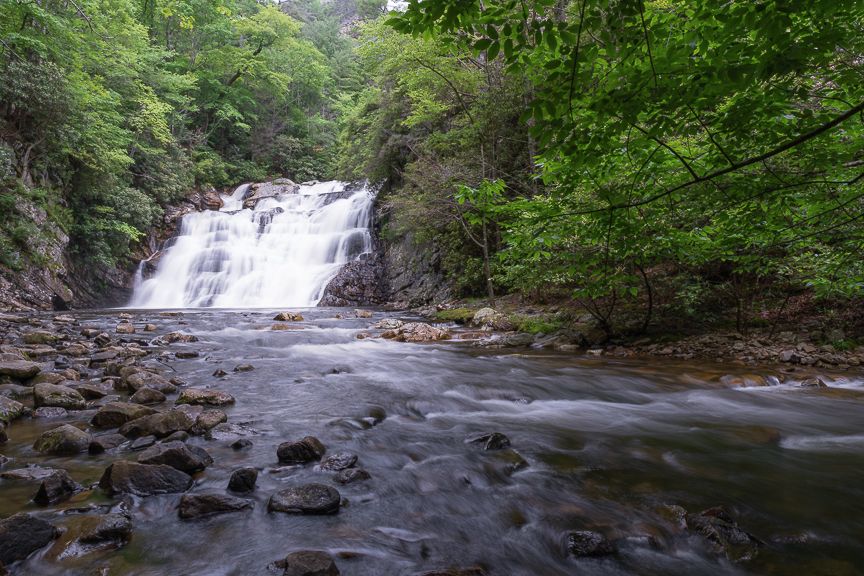
Laurel Falls
Laurel Falls
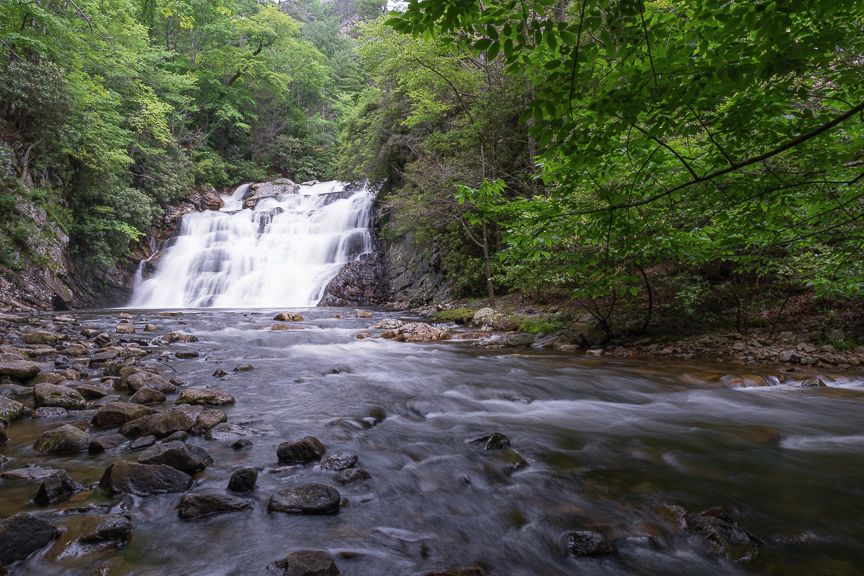
Laurel Falls, in Tennessee's Pond Mountain Wilderness, is the one I think of as the big sister to Looking Glass — similar in grandeur and flow, framed by rock faces with shrubs and ferns growing straight out of the stone. Getting there is a moderate hike of close to five miles RT that traces the Laurel Fork of the Doe River and meets the Appalachian Trail along the way. The whole route is worth the camera, not just the destination: clear, cold water, sheer rock, and forest the entire way. In spring it runs with wildflowers; in summer the falls spill into a wide swimming hole that draws a crowd.
The trade-off for photographers is light. Laurel gets direct sun, which is fine if you're there to swim and less so if you're there to shoot — so aim for early morning, late afternoon, or a cloudy day. The good news is that the base is spacious. Even on a busy day you can usually find room to work a composition. Bring a sturdy tripod and water shoes so you're not stuck on the shoreline; my preferred frame here is wide, with the river running toward the camera.
One caution: I've only hiked this in the warmer months. One stretch follows a narrow path along a rock face directly above the river, and I can only imagine how slick that turns in winter.
The details
- Location: Pond Mountain Wilderness, TN. About 1 hour 20 minutes from Asheville.
- Trail: Moderate, roughly 5 miles round trip; follows the Laurel Fork of the Doe River and intersects the AT.
- Note: A narrow rock-face section sits directly above the river — likely icy and dangerous in winter.
- Best lens: Wide angle, with the river leading toward you.
- Best conditions: Early, late, or overcast (it gets direct sun); spring wildflowers; summer for the swimming hole.
- Crowds: Busy in summer, but the base is roomy enough to work around.
Schoolhouse Falls
Schoolhouse Falls sits in Panthertown Valley, near Lake Toxaway outside Brevard, and it's the most accessible fall in a whole network of trails that connect to many more. That makes it the right pick if you want to spend a full day chasing waterfalls without driving between them. What sets Schoolhouse apart is the water itself — stained a deep tannin brown that reads almost black, colored by years of fallen leaves. It's at its best in autumn, ringed by color. A wide swimming hole at the base makes it a summer favorite too.
Like Laurel, it sees sun at certain hours, so bring your filters and time your visit for softer light. Water shoes help you get off the bank and into a better position.
The details
- Location: Panthertown Valley, near Lake Toxaway outside Brevard, NC. About 90 minutes from Asheville.
- Trail: The most accessible fall in the Panthertown network and a gateway to many more. 1.3 miles from trailhead, 2.6 miles round trip.
- Best lens: Wide angle; pack a polarizer and ND filter.
- Best conditions: Fall for color; softer light hours, since it gets sun. The dark tannin water is the signature.
- Crowds: Popular in summer for the swimming hole.
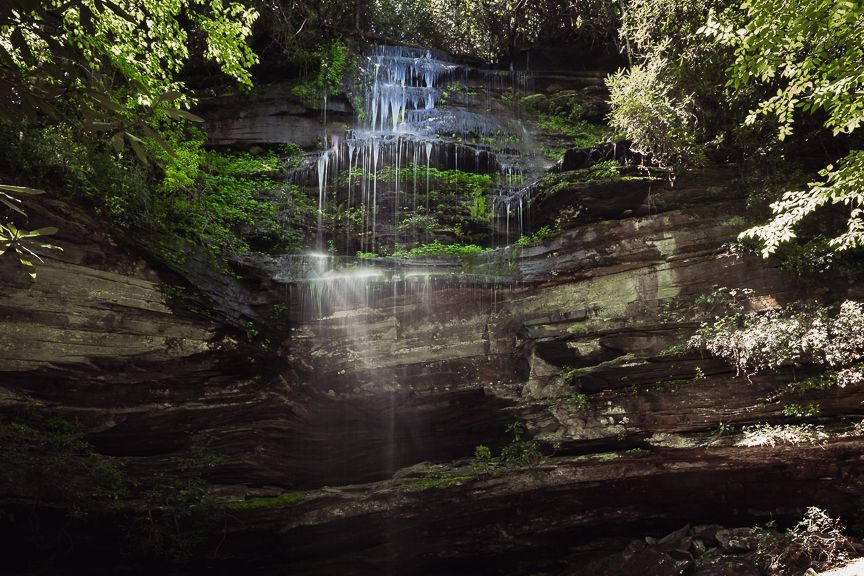
Rhapsodie Falls
I'm closing with the one almost nobody knows. Rhapsodie Falls is the least-famous fall on this list and the one I've most often had entirely to myself. The hike in is reasonably flat until the end, where it climbs steeply and then asks for a bit of a scramble down to the base — worth every awkward step. Where the others run with grandeur and volume, Rhapsodie is delicate, a lighter flow falling from a real height. The payoff is that you can walk behind it and stand in a cavern thick with moss and fern, watching the water come down in front of you. Go wide, and bring a sense of adventure.
Finding it is half the challenge. Parking is limited, and the road to the trailhead splinters off the main road at a spot that's easy to drive right past. Pull up directions before you lose signal.
The details
- Location: About 1 hour 24 minutes from Asheville. The trailhead is easy to miss — use AllTrails for directions.
- Trail: Mostly flat, then a steep climb and a short scramble to the base. 3.1 miles roundtrip.
- Note: Limited parking.
- Best lens: Wide angle — you can shoot from behind the falls.
- Best conditions: A delicate flow; the walk-behind cavern is the whole draw.
- Crowds: Minimal. Often empty.
One More, When the Parkway Reopens
Crabtree Falls is one of the region's finest, but it sits off a section of the Blue Ridge Parkway still closed from Hurricane Helene. When that stretch reopens — current estimates point toward 2027 — it earns a place on this list. For now, it's out of reach from Asheville. Check the NPS Blue Ridge Parkway closure page before you plan around it.
When to Go and What to Wish For
Forget the bluebird forecast. For waterfalls, you want flat light and full water. An overcast sky is the single most useful condition you can ask for — it tames the contrast between white water and dark rock and lets you drop your shutter speed without overexposing. A light drizzle is even better, as long as you can keep your front element dry.
Water volume comes from rain, so the best flow arrives a day or two after a good soaking. Right after a storm, the creeks can run muddy; give them a beat to clear. And unlike almost everything else in landscape photography, midday is fine here — the canopy and the cloud cover do the work that golden hour does elsewhere.
Season changes the character of every one of these. Spring brings wildflowers, rhododendron, and the heaviest flow. Summer fills both the swimming holes and the trailheads. Fall frames the falls in color — my favorite for places like Schoolhouse. And winter, after a hard freeze, can turn the accessible falls like Looking Glass and Moore Cove into something else entirely.
How to Photograph Moving Water
You can shoot a passable waterfall handheld, but you can't shoot a great one. Slow shutter speeds are the whole point, and that means a tripod isn't optional. Here's the short version of what works:
- Use a tripod and a remote or two-second timer. Any slow exposure will exhibit camera shake otherwise.
- Put a polarizing filter on the lens. It cuts the glare off wet rock and leaves and pulls real saturation out of the scene. This is the one filter I'd never leave behind for waterfalls.
- Choose your shutter speed for the look you want. Around a quarter-second to one second keeps texture and motion in the water. Push past a few seconds, and it goes silky and smooth. Try both — the right answer depends on the fall.
- Add a neutral-density filter in bright conditions. On a sunny day, you can't get a slow shutter without one. An ND buys you those long exposures even at midday.
- Keep ISO low and aperture moderate. ISO 100 and f/8 to f/11 give you clean files and enough depth of field without softening from diffraction.
- Watch your highlights. White water blows out fast. Expose for the brightest part of the falls and lift the shadows later, or bracket if the range is wide.
One more, learned the hard way: keep a microfiber cloth in a pocket. Spray will inevitably find your lens, and a single drop on the front element will quietly ruin frame after frame before you notice.
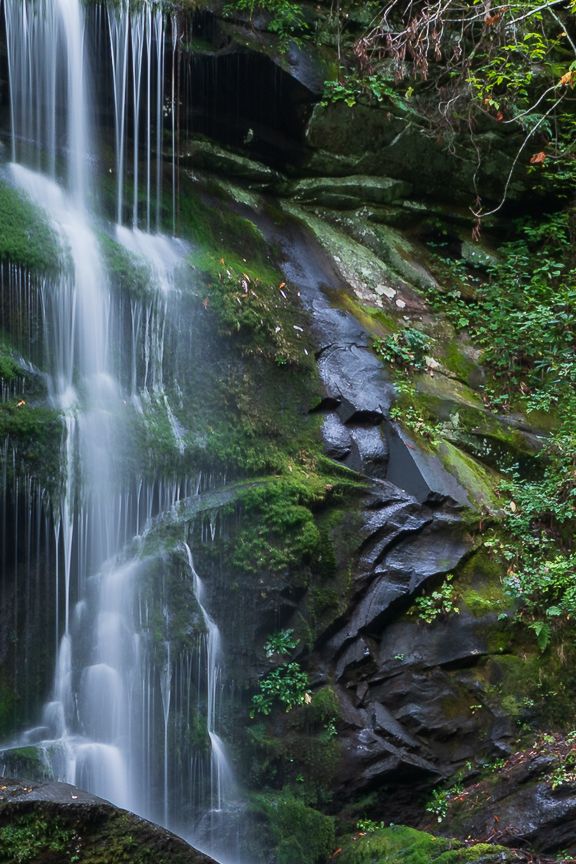
Catawba Falls Detail
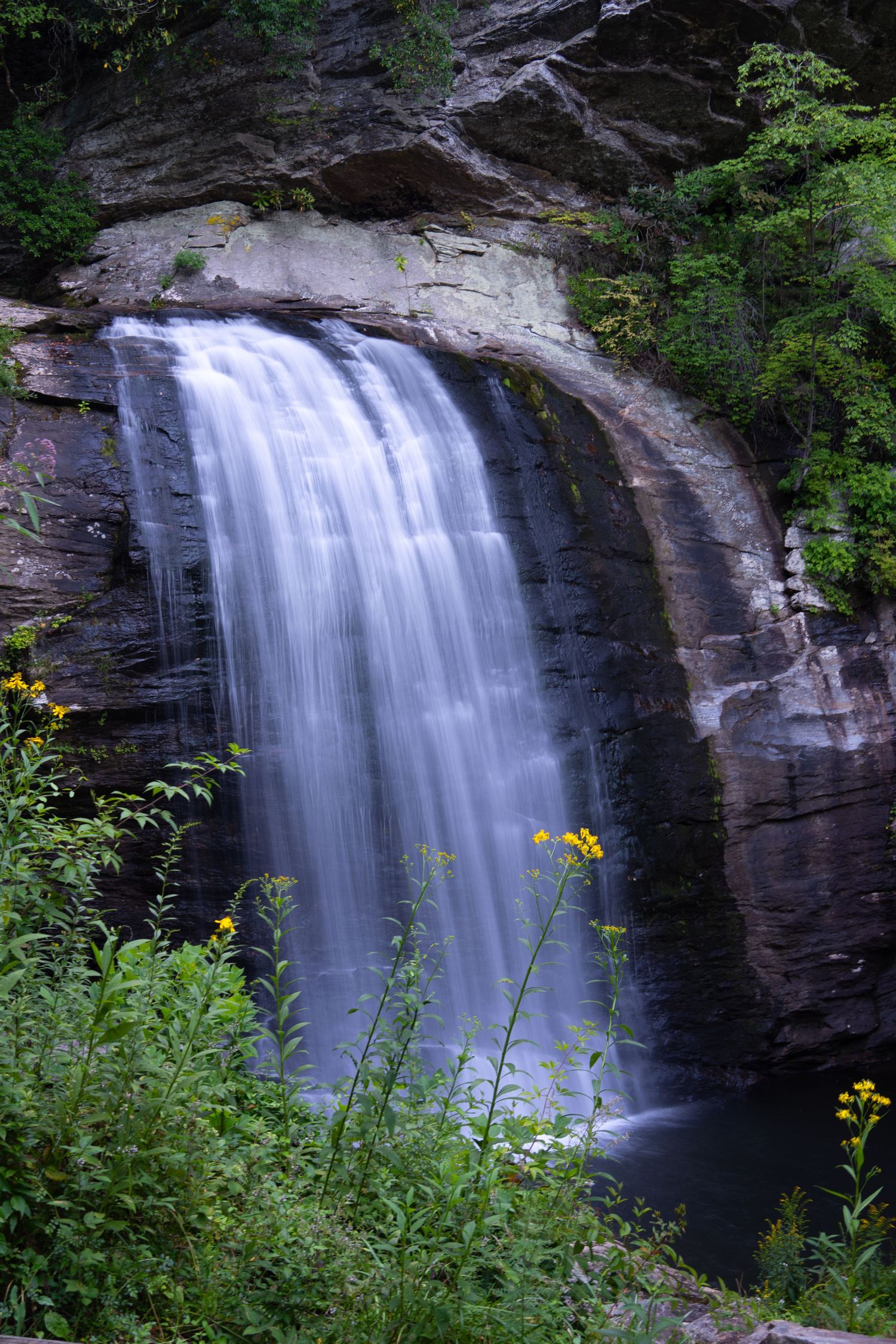
Looking Glass Falls in Summer
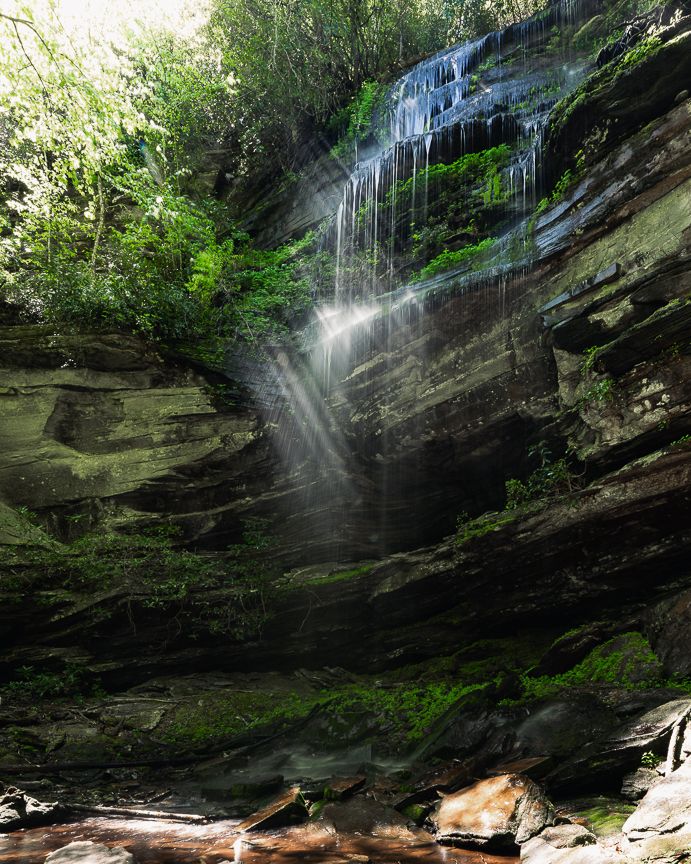
Rhapsodie Falls
What to Bring and How to Stay Safe
This isn't a hiking guide, but a few things are worth saying. The real hazard at every one of these falls isn't the trail — it's the wet rock at the bottom. It's far more slick than it looks, and people get hurt every year scrambling for a better angle. Move deliberately, test your footing, and decide before you climb whether the shot is worth the risk to yourself AND your gear. Often it isn't.
Beyond that: water shoes or shoes you don't mind soaking for the crossings, trekking poles for the longer trails, layers for the temperature drop near the spray, and more water and snacks than you think you'll need. Tell someone where you're going and make sure you download the route on the ones with poor signal, especially Rhapsodie.
Frequently Asked Questions
What is the best beginner-friendly waterfall near Asheville? Looking Glass Falls and Moore Cove Falls, both on Highway 276 in Pisgah National Forest, are the most accessible. Looking Glass is steps from a roadside platform, and Moore Cove is a short, easy trail a few miles farther on. You can photograph both in a single outing without a demanding hike.
Can I bring my dog on these waterfall hikes? Many of these trails allow leashed dogs, but Catawba Falls involves a steep staircase that's hard on small dogs and dogs uneasy with heights. Always check current trail rules before you go, since regulations can change.
Do I need a tripod to photograph waterfalls? Yes, if you want the smooth, flowing-water look that comes from a slow shutter speed. A tripod holds the camera steady through exposures too long to handhold. Pair it with a polarizing filter and you have the two pieces of gear that matter most for waterfall photography.
When is the best time of year to photograph waterfalls near Asheville? Spring offers the heaviest flow and wildflowers, fall frames the falls in color, and winter can bring ice to the accessible falls after a hard freeze. In any season, an overcast day a day or two after rain gives you the best combination of light and water volume.
Getting Out There
Seven falls, two states, and a single truth tying them together: the photographer who shows up in the gray, after the rain, and is willing to climb down off the platform comes home with the frame nobody else has. Start with the easy icons. Save Rhapsodie for the day you want the trail to yourself. And whatever else you forget, bring the polarizer.
Check out more fine art prints of Western North Carolina waterfalls and landscapes here.
If you run a property, brand, or destination in these mountains and want images like these for your own audience, let's talk.