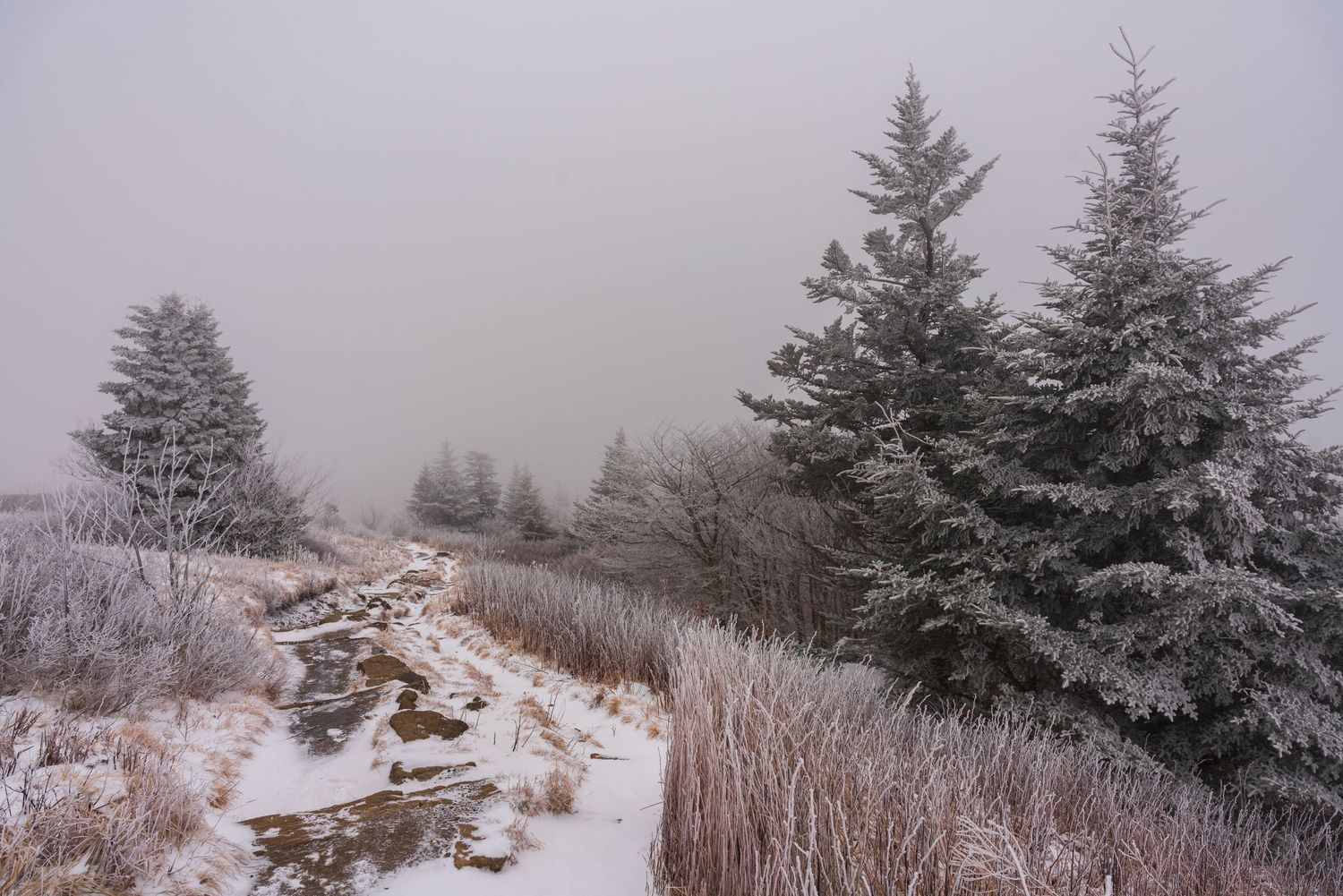
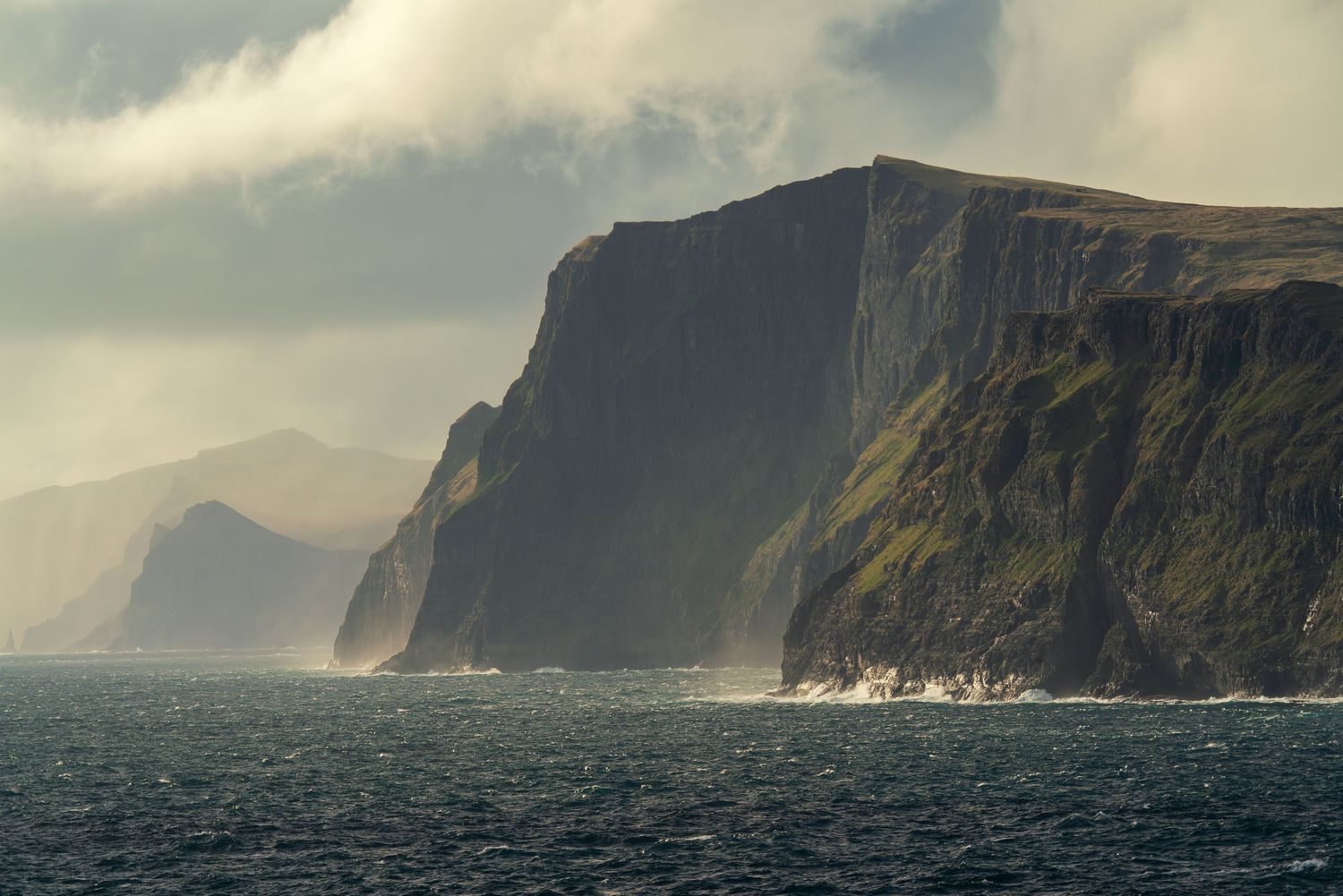
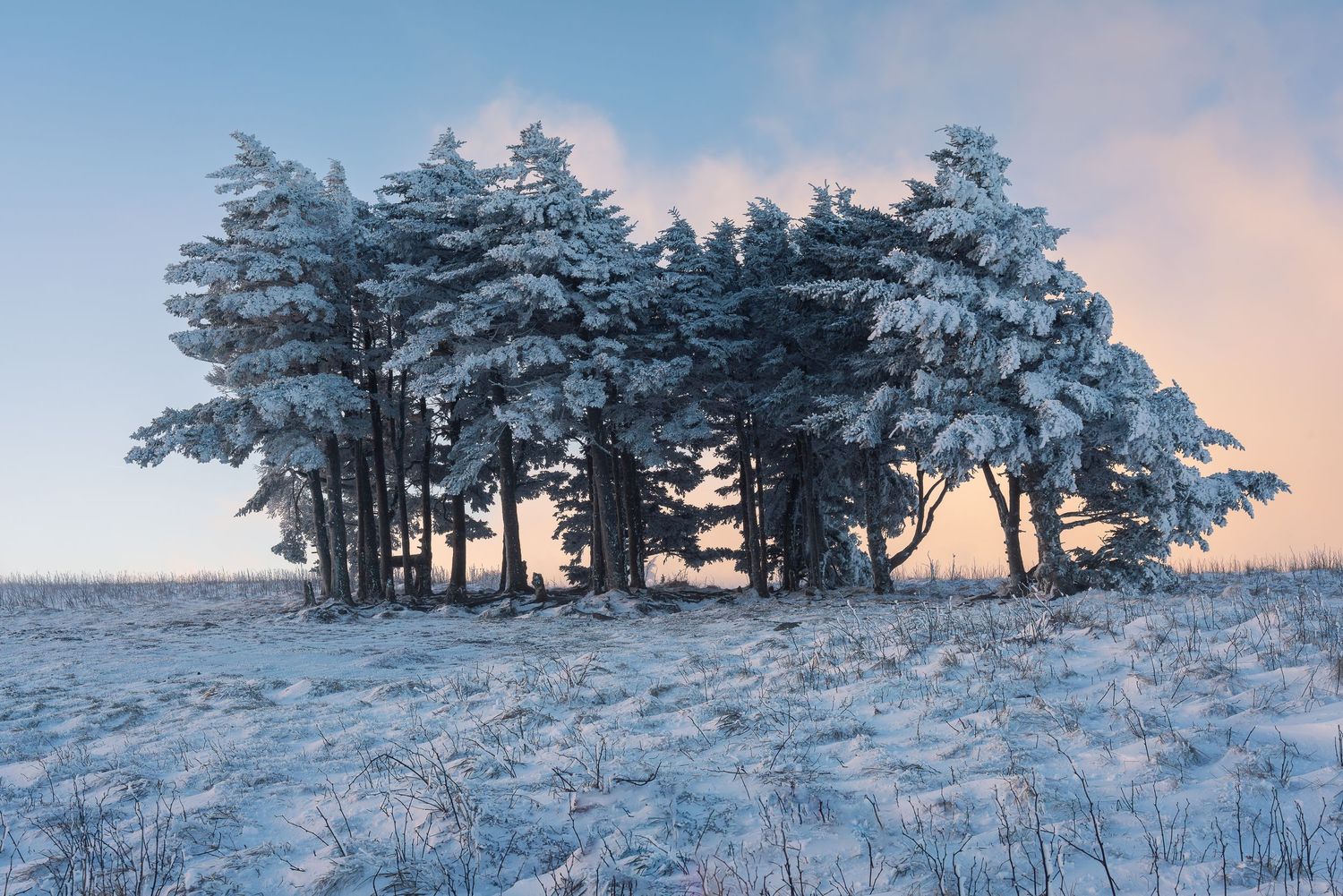
For one sunrise at Carvers Gap on Roan Mountain, the thermometer read 4°F. The wind chill sat well below zero, and by the time the light came up, I had icicles on my eyelashes. It was colder than any morning I found in Lofoten, well inside the Arctic Circle. It was also a ninety-minute drive from home, toward the Tennessee line, because that is where winter mostly lives now.
I've lived in Western North Carolina for more than twenty years, and I started going out in winter almost ten years ago. Each year since, it has been harder to find. Less snow, farther to drive, and a season that keeps getting less predictable. This is a look at winter in Western North Carolina, past, present, and future: what the records show, what the forest at the top of the range shows, and what I've watched from behind a camera.
What Winter in Western North Carolina Used to Look Like
These mountains have always made their own weather. Mount Mitchell, at 6,684 feet, the highest peak east of the Mississippi, holds North Carolina's cold records: −34°F on January 21, 1985, and 36 inches of snow in a single day on March 13, 1993. Most of the state averages less than 5 inches of snow a year. The highest peaks can get up to 80.
That split is the whole story of winter here. Down in Asheville, snow has always come and gone in a day or two. At elevation, along the Black Mountains, the Great Balsams, and the Roan Highlands, winter used to settle in and stay.
In the more than two decades I've been in Asheville, I can remember only one white Christmas. Generally, we are lucky to get one solid storm each year that results in snow days for the school kids, sledding at the neighborhood park and largely shutting the city down for a few days. Increasingly, our most intense winter storms arrive as ice.
I'm careful with nostalgia. Asheville had some very warm winters in the 1930s and the 1950s, and we all know that one mild season proves nothing. What has changed is the frequency of them.

Is Winter in Western North Carolina Getting Warmer?
Yes, and the strongest warming is recent. The numbers worth knowing:
- North Carolina's winters from 2001 to 2023 averaged 43.0°F**, 1.8°F warmer than the 20th-century average of 41.2°F. *(NC State Climate Office)*
- Six of the state's eleven warmest winters on record have come since 2011.** *(NC State Climate Office)*
- Winter nights are warming slightly faster than winter days.** Overnight lows are up 1.9°F, daytime highs 1.8°F. *(NC State Climate Office)*
- Asheville's winters from 2016 to 2025 averaged 42.3°F**, about 3.3°F warmer than the 20th-century average of 39.1°F. This is my own calculation from the National Weather Service's monthly record, December through February.
- Asheville's eight warmest years on record have all come since 2012.** 2024 was the warmest, at 59.2°F. *(National Weather Service)*
Snow on the ground lasts when the night refreezes it. When the low rises above freezing, a morning of snow is slush by noon.
What the records don't capture is what I notice most, which is the unpredictability. Some winters are marked by ice storms. Others by a few days of deep freeze, and then nothing. Most often, the best way to see snow is to head west to the Blue Ridge Mountains, where the snow lands first. More often than not, a snowy photograph from these mountains means leaving in the dark before dawn and heading for the Tennessee line.
The Spruce-Fir Forest at the Top of the Range
The highest summits here hold a forest that doesn't belong this far south. When the last ice age ended, and the glaciers retreated north, red spruce and Fraser fir climbed to the coldest ground they could find and stayed. Scientists call these summits sky islands: patches of northern forest stranded on top of southern mountains. Fraser fir grows naturally nowhere else on earth.
The forest is small and in trouble. Pisgah and Nantahala National Forests hold about 16,000 acres of spruce-fir. A 1995 federal report ranked the red spruce and spruce-fir forests of the central and southern Appalachians among the most endangered ecosystems in the United States.
Climate didn't start that decline. An invasive insect, the balsam woolly adelgid, did most of the damage. On Mount Guyot in the Smokies, Fraser fir fell from 80% of the living canopy trees to 2.5% between 1967 and 1985. Warming is the next pressure on a forest that has already been through a lot, and the problem is simple geography. A cold-loving forest at the top of a mountain has nowhere higher to go.
The animals that live there have even less room. The Carolina northern flying squirrel, which depends on this high spruce forest, has been federally endangered since 1985. The spruce-fir moss spider lives only in damp moss mats under the high firs of western North Carolina and eastern Tennessee, and it can't survive if the moss dries out.
There is good news in the record too. Since the Clean Air Act cut acid rain, red spruce seedlings have been increasing in the understory, even at lower elevations once thought unsuitable. A forest that was written off is putting down roots.
A big bonus for winter hikers in the high country near Asheville is the ubiquitous Christmas-tree scent you'll find along the trail. Even meandering up to area balds like Black Balsam and Roan, the route will take you through the evergreens, while on other routes near Mt. Mitchell, the trees provide shelter from the high, brisk winds that winter often brings.

Helene, and Having a Word for It
In September 2024, Hurricane Helene carried rain from an unusually warm Gulf of Mexico and dropped it on these mountains. World Weather Attribution found its rainfall about 10% heavier because of climate change, and rain like it up to 70% more likely in the central and southern Appalachians. Some totals had a recurrence interval of more than 1,000 years. The storm set off more than 2,000 landslides.
Helene was not a winter storm, and this isn't an article about hurricanes. But it changed how I see these mountains. Trails I had walked for twenty years were gone, and so, for a long time, was the ability to get outside at all. What helped me navigate the loss was a phrase: environmental grief. I didn't have language for what I felt until I found it, and having a word for it made the situation easier to talk about.
Vanishing Winters carries a slower version of that feeling. A season changing over decades doesn't arrive in one night the way a flood does. It's easy to miss until you realize how far you're driving to find it.
What Winter Here Could Look Like by 2100
The projections for North Carolina depend on choices still being made. From the state's NOAA climate summary:
- Under a lower-emissions pathway, the coldest end-of-century projections are about 1.9°F warmer than the 1901 to 1960 average.
- Under an intermediate pathway, end-of-century projections range from about 3.6°F to 8.8°F above that average.
- Under the intermediate and higher pathways, the summary calls the warming projected this century "historically unprecedented."
- Extreme rain is projected to become more frequent and more intense.
Closer to the ground, North Carolina's stocked trout streams have warmed about 0.05°C per year since 1992, and many could get too warm for trout by 2050.
I read the gap between those pathways as the hopeful part. The difference between 1.9°F and 8.8°F is a range, and where we land in it is still being decided.
What I Hope You Carry Out of the Room
Vanishing Winters is a photographic elegy for winter in three places that were once one mountain range: Iceland, the Lofoten Islands in Norway, and the Southern Appalachians. The exhibition hangs at Pink Dog Creative in Asheville's River Arts District from December 5, 2026 to January 2, 2027. The Appalachia wall hangs last, because this is the winter I know best, the one outside my own door.
An elegy honors something while there is still time to notice it. I'd like people to walk out of Pink Dog wanting to go outside this winter, and to pay attention to what they find when they get there. The ice on a fir branch at sunrise. How far they drove to see it.

Winter in Western North Carolina: FAQ
Q: Does it still snow in Asheville?
A: Yes, though rarely for long. Most of North Carolina averages less than 5 inches of snow a year, and in Asheville snow usually melts within a day or two. Reliable snow lives at the highest elevations, where the peaks can get up to 80 inches in a season.
Q: Where can I see snow near Asheville in winter?
A: Head high and toward the Tennessee line. The Roan Highlands around Carvers Gap, about 90 minutes from Asheville, and the Black Mountains around Mount Mitchell hold snow far more often than town does. Check road conditions before you go. Sections of the Blue Ridge Parkway close in snow and ice, and the National Park Service posts closures online.
Q: What is the spruce-fir forest in the Southern Appalachians?
A: It's a forest of red spruce and Fraser fir on the region's highest summits, left behind when the last ice age ended. Fraser fir grows naturally nowhere else on earth. The forest covers about 16,000 acres in Pisgah and Nantahala National Forests and is considered one of the most endangered ecosystems in the United States.
Q: Is climate change affecting winter in the Southern Appalachians?
A: Yes. North Carolina's winters have warmed about 1.8°F compared with the 20th-century average, with six of the eleven warmest on record since 2011, and winter nights are warming slightly faster than days. NOAA projects further warming this century, with the amount depending on future emissions.
Q: Where can I see the Vanishing Winters exhibition?
A: At Pink Dog Creative, 348 Depot Street in Asheville's River Arts District, from December 5, 2026 through January 2, 2027. The opening reception is Saturday, December 5, from 5 to 7 PM, free and open to everyone.
The Winter That Used to Come Here
Winter still comes to Western North Carolina. It comes in shorter windows, higher up, and less often to the places most of us live. That's the reason to go looking for it this year, while it's here. Pack the extra layers, leave before light, and drive toward the Tennessee line. And if you're in Asheville this December, come see the rest of the story on the walls at Pink Dog.
This project was supported by ArtsAVL, Bank of America, and the North Carolina Arts Council, a division of the Department of Natural and Cultural Resources.